Your Heart Has Been Trying to Talk to You.
-
By Tyesha Lewis
Are You Listening?
A clear, honest guide to cardiovascular disease in women, the warning signs, the statistics, the tools to check yourself, and what to do if something feels wrong.
Here is a fact that might stop you in your tracks: coronary heart disease kills more than twice as many women in the UK as breast cancer every year. Yet most women are far more worried about breast cancer than their heart.
Heart disease has long been thought of as a man’s problem. It isn’t. Right now, there are more than 3.6 million women in the UK living with heart disease. Every single hour, an average of three women in the UK die from coronary heart disease.
The good news? Most cardiovascular risk is modifiable. That means what you do and how quickly you act genuinely matters. So let’s talk about it.
What Is One of the First Signs of Cardiovascular Problems?
One of the earliest and most commonly missed signs is unusual fatigue not just being tired after a busy day, but a deep, persistent exhaustion that doesn’t go away with rest. Many women write this off as stress, hormones, or just being busy. But when fatigue is combined with any of the symptoms below, it deserves attention.
Other early warning signals include shortness of breath doing everyday things (climbing stairs, walking to the car), a fluttering or racing heartbeat that comes and goes, and mild but persistent chest discomfort not necessarily sharp pain, but a dull heaviness or tightness that doesn’t fully go away.
“In my experience, many women don’t have the ‘Hollywood heart attack’ we think of. Instead they may feel unusual fatigue, shortness of breath, nausea, or simply a sense that ‘something’s off’.” — Dr Nouran Sorour, Cardiologist
Warning Signs of Heart Problems in Women: Know These
Women and men generally experience the same heart attack symptoms, but women are more likely to dismiss them or not connect them to the heart. Here are the signs to take seriously:
- Chest pain, pressure, tightness, or squeezing — this is still the most common sign. In women it often feels dull or heavy rather than sharp.
- Pain spreads to the arm, neck, jaw, back, or upper stomach — this often surprises people because they don’t expect pain in those places.
- Shortness of breath — even when resting, or with mild activity you used to manage easily.
- Nausea or vomiting — often mistaken for a stomach issue or food poisoning.
- Feeling cold, clammy, or sweaty — breaking into a sweat without any physical reason.
- Dizziness or lightheadedness — especially if it comes on suddenly or alongside other symptoms.
- Heart palpitations — a fluttery, racing, or irregular heartbeat.
- Swollen ankles, feet, or legs — a sign the heart may not be pumping efficiently.
🚨 EMERGENCY: If you have sudden, severe chest pain that doesn’t stop — or any combination of the above symptoms — call 999 immediately. Do not drive yourself. Do not wait to ‘see how you feel’. Minutes matter.
Why Heart Disease in Women Gets Missed So Often
For decades, most heart disease research was done on men. That meant many of the ‘classic’ warning signs we all learned about the dramatic chest-clutching you see in films were based on how heart attacks look in men, not women.
Women’s symptoms are more often vague, gradual, or easy to explain away. They’re also frequently misdiagnosed as anxiety, acid reflux, or stress sometimes even by doctors. Research shows that women have a higher chance of receiving the wrong initial diagnosis after a heart attack.
Hormonal changes after menopause also increase risk significantly. Oestrogen has a protective effect on the heart, so when levels drop, blood pressure often rises, cholesterol patterns change, and arteries become stiffer. Many women find they develop cardiovascular problems in their 50s and 60s that simply weren’t there before.
Early Signs of Heart Disease in Females: Don’t Ignore These
These are the quieter, slower-building signs that often show up months or even years before a cardiac event:
- High blood pressure that’s slowly creeping up — often symptom-free, which is why it’s called the ‘silent killer’. Get it checked regularly.
- High cholesterol — after menopause, LDL (‘bad’) cholesterol often rises without any change in diet. A blood test is the only way to know.
- Recurring chest discomfort on exertion (angina) — a heaviness or ache in the chest when walking briskly or climbing stairs that fades at rest.
- Getting breathless more easily than you used to — this is worth mentioning to your GP, especially if it’s a new or worsening change.
- A history of pre-eclampsia or gestational diabetes in pregnancy — these conditions raise your long-term cardiovascular risk. Tell your doctor if this applies to you.
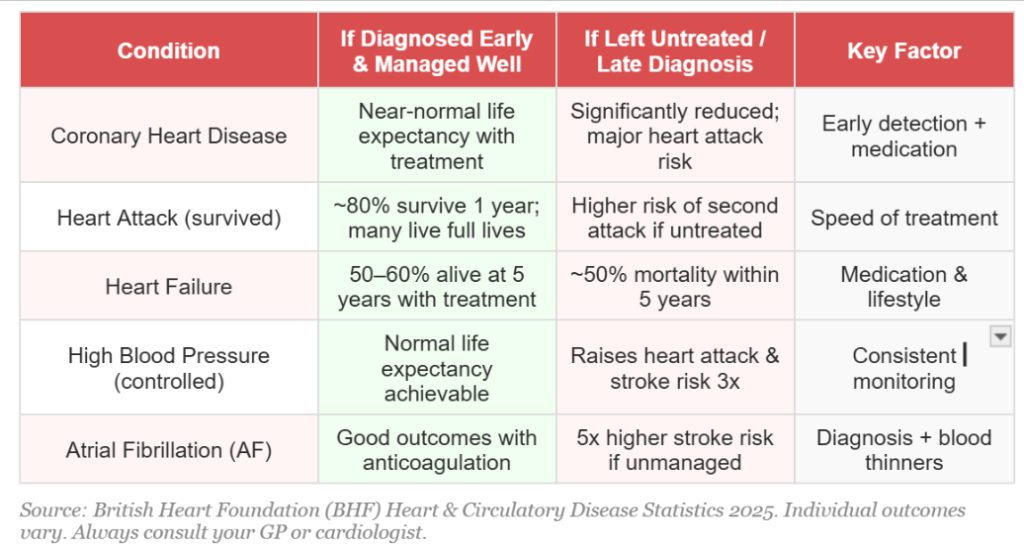
Heart Disease in Women: Life Expectancy at a Glance
Outcomes vary hugely depending on when heart disease is caught and how well it is managed. The chart below gives a general picture based on UK-based clinical data and BHF research. These are averages individual results vary significantly with treatment, lifestyle, and timing of diagnosis.
Am I Having a Heart Attack? Take This UK Quiz
If you’re feeling something and something feels wrong – trust that feeling. Women are much more likely than men to delay calling for help, often because they’re not sure if their symptoms are ‘serious enough’ or worry about making a fuss.
The British Heart Foundation (BHF), the UK’s leading heart charity, has resources specifically for women to understand their symptoms and risk. Their heart attack symptoms page includes clear guidance on what to look for and when to act.
💻 UK HEART SYMPTOM RESOURCES:
BHF — Heart Attack Signs & Symptoms in Women: bhf.org.uk/informationsupport/conditions/heart-attack/signs-and-symptoms-of-heart-attacks-in-women
NHS Heart Age Test (ages 30–74): nhs.uk/conditions/nhs-health-check/
BHF Cardiac Nurse Helpline (free):0808 802 1234 — Monday to Friday, 9am–5pm
Remember: a quiz or symptom checker is a starting point, not a diagnosis. If you are having severe or sudden symptoms — call 999 right now. Don’t search the internet. Don’t drive yourself. Call.
What You Can Do Starting Today
- Book an NHS Health Check — if you’re aged 40–74 and in England, you’re entitled to a free check every 5 years. It checks blood pressure, cholesterol, and overall heart risk. Ask your GP surgery.
- Know your numbers — blood pressure (aim for below 130/80), cholesterol, and BMI. You can’t manage what you don’t measure.
- Talk to your GP about menopause and heart health — if you’re in perimenopause or post-menopause, ask specifically about your cardiovascular risk. HRT may help protect the heart when started early.
- Move more, smoke less, stress differently — 30 minutes of moderate activity five days a week makes a measurable difference to heart health. So does quitting smoking (the single biggest modifiable risk factor).
- Push for answers — if a symptom doesn’t feel right and you’re being told it’s just anxiety or stress, ask for a second opinion or a referral. You know your body.
Your Heart Deserves the Same Attention as Everything Else
We spend time on our skin, our hair, our diet, our fitness goals. But the heart, the organ doing the most extraordinary, non-stop work of all, often gets ignored until something goes wrong.
The good news is this: most cardiovascular risk is modifiable. Caught early, managed well, and supported properly heart disease does not have to write the end of your story.
Your 40s, 50s, and beyond can be a chapter of energy, strength, and vitality. It starts with knowing what to listen for and being brave enough to act when something says pay attention.
Quick Reference: Heart Health in Women
- One of the first signs: Unusual, persistent fatigue
- Key warning signs: Chest pressure/tightness, shortness of breath, jaw/arm/back pain, nausea, sweating, palpitations
- Early signs: High blood pressure, rising cholesterol, breathlessness on exertion, recurring chest discomfort
- Life expectancy: Dramatically improved with early detection and treatment
- UK resources: bhf.org.uk | NHS Health Check (ages 40–74) | BHF helpline: 0808 802 1234
- Emergency: Call 999 immediately if symptoms are sudden, severe, or don’t stop
This blog is for general informational purposes only and does not constitute medical advice. If you are concerned about any symptoms, please contact your GP, call NHS 111, or in an emergency call 999. Always seek professional medical advice for diagnosis and treatment.
NOURISH. PROTECT. GLOW with SOLEILRA